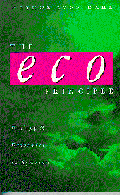
The Eco Principle: Ecology and
Economics in Symbiosis
Arthur Lyon Dahl
Zed Books, London, and George Ronald, Oxford, 1996.
Presently out-of-print from George Ronald but exploring print-on-demand
Download text as pdf
Download scan of the published book 122mb as pdf
The book based on systems science shows that the rules that govern the life of organic systems also govern social and economic systems. It draws on the Bahá'í teachings and the scientific study of living systems to produce a highly original theory demonstrating how the same fundamental rules and structures govern the life and death of organic and social systems. From the humble bacteria to the most highly developed nation state, systems must be able to transform themselves to meet the ever-changing challenges of their environment. The book brings together the teachings of Bahá'u'lláh with the best of scientific thought to produce an accurate analysis of the world situation as well as a tool to help humankind move forward into its collective adulthood.
CONTENTS
1. Paradigms in conflict
2. It isn't working
Economics trapped in its own specialization - Economics as if people didn't matter -
The market - Waste and war as economic forces - Trade and the global economy -
Employment - Waste and pollution - Dominance of the short term - Growth -
Rates of growth - Power and money
3. Where are we going?
Population - Non-renewable resources - Energy - Renewable resources - The human
environment - Technologies - Wastes - Poverty - Consequences
4. The Theory of Ecos
Definition of an eco - Information content - Energy flow - Dynamics - Structure -
Functions - Efficiency - Examples - Ecos as systems - The evolution of information
capacity - Why a theory of ecos?
5. Ecos in nature
Microbes and plants - Animals - Ecosystems
6. A more organic economics
Organic economics - Economic ecos - Information as wealth - Information: the
privatization of the commons - Statistics and measurements - Economics and the
national eco - Other economic ecos - The global economy - Scarcity and population -
The cancer of power
7. Human capital
Human dimensions - The value of people - Information and people - Two kinds of knowledge
- Functional values - Sources of values - Changing values - Eco-values - Education and
human capacity - Involvement - Putting people first - Responsibilities of society -
Business and employment - Accounting for human capital
8. Organic communities and institutions
The new technological environment - Some principles of organic social organization -
Size and scale - Institutional requirements - World Government - More organic structures
- Business - Civil society - The fallacy of permanence - Bureaucracy: the final solution
9. Visions of an eco-civilization
The fear of change - The organic framework of ecos - The knowledge society - Some
characteristics of future society - The first steps
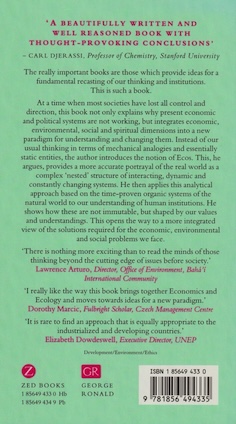
ISBN: 978-0-85398-434-9
192 pages
21.4 x 13.6 cm. (8.5 x 5.25 in)